Events Categories
CETANB Centre for Emerging Technology and Atma Nirbhar Bharat
CMHCS Centre for Military History and Conflict Studies
CP&L Centre for Publications & Library
CPME Centre for Professional Military Education
CS3 Centre for Strategic Studies and Simulation
CUNHS Centre for United Nations and Humanitarian Studies
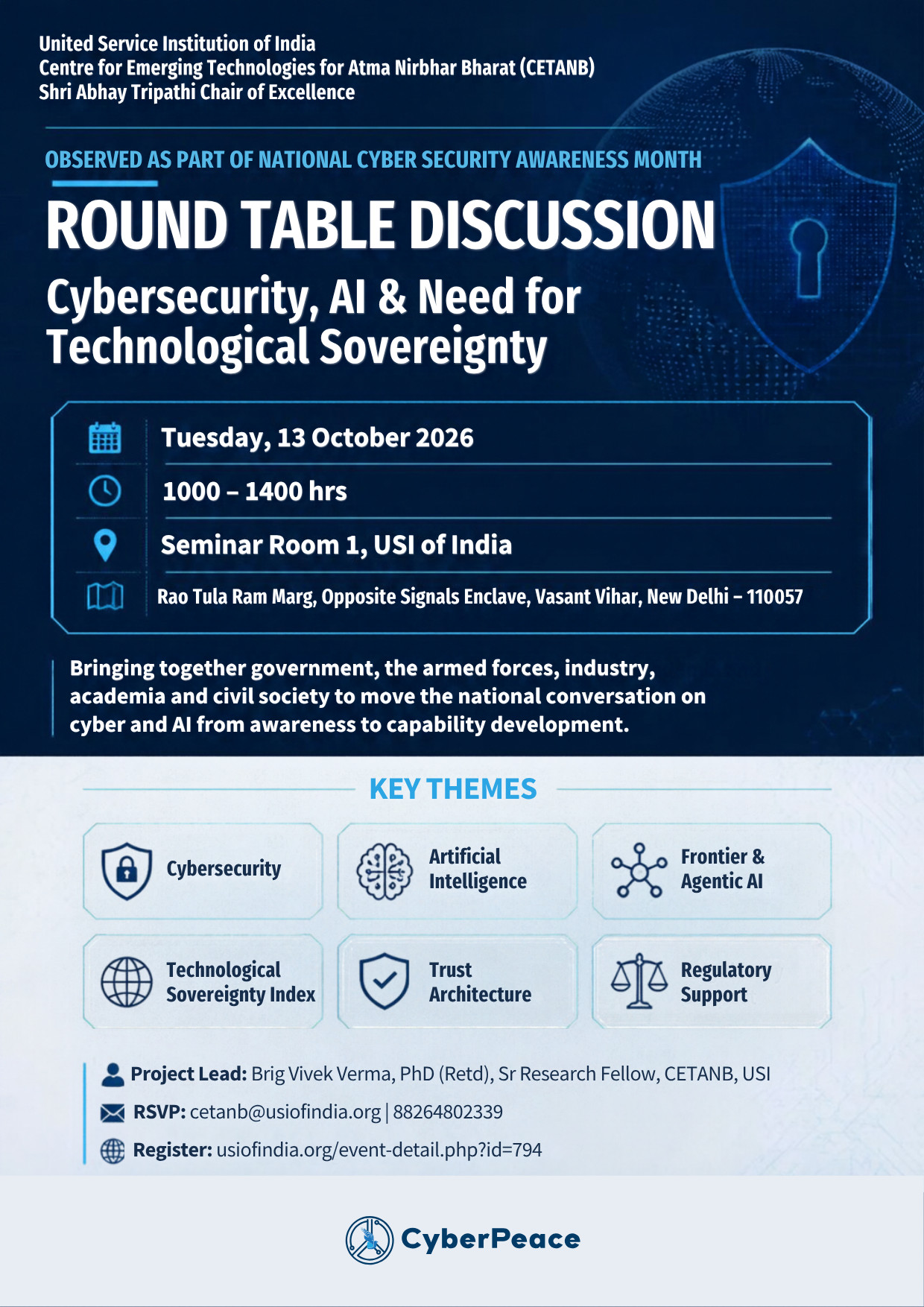
Round Table Discussion: Cybersecurity, AI & Need for Technological Sovereignty
UNITED SERVICE INSTITUTION OF INDIA
Centre for Emerging Technologies for Atma Nirbhar Bharat (CETANB)
Shri Abhay Tripathi Chair of Excellence
Rao Tula Ram Marg, Opposite Signals Enclave, Vasant Vihar, New Delhi – 110057
ROUND TABLE DISCUSSION (RTD)
Cybersecurity, AI & Need for Technological Sovereignty
Tuesday, 13 October 2026 | 1000 to 1400 hrs | Seminar Room 1, USI of India
CONCEPT NOTE
October is observed in India as National Cyber Security Awareness Month, led by the Indian Computer Emergency Response Team (CERT-In) under the Ministry of Electronics and Information Technology (MeitY). The 2025 edition carried the theme “Cyber Jagrit Bharat”. This Round Table, held on 13 October 2026 as part of the observance, aims to shift the national conversation on cyber and AI from awareness to capability development.
In April 2026, Anthropic confined its Claude Mythos Preview model to a closed defensive programme, Project Glasswing, after the model found thousands of previously unknown vulnerabilities in major operating systems and browsers; by May 2026 the programme had reported more than 10,000 high- or critical-severity flaws. When discovery is automated, the interval between a flaw being found and being exploited shrinks, and patching capacity becomes a measure of national resilience.
In the World Economic Forum’s Global Cybersecurity Outlook 2026, 94% of respondents named AI as the most significant driver of change in cybersecurity, and 87% identified AI-related vulnerabilities as the fastest-growing cyber risk. 31% reported low confidence in their country’s ability to respond to a major cyber incident, up from 26% a year earlier. The report names sovereignty and unequal access to capability as structural risks.
Recent episodes illustrate how dependency is now a security risk. On 12 June 2026, a US export control directive suspended access by foreign nationals to two frontier AI models; because the provider could not separate users by nationality, it withdrew the models for all customers worldwide until the controls were lifted on 30 June 2026. More than 38,000 GPUs are onboarded under the IndiaAI Mission — as the Government itself notes, manufactured primarily in one country. Models, connectivity and compute can each be withdrawn or disrupted from outside national control.
Cybersecurity and AI now determine how securely societies function. AI is reshaping public services, the economy and the information environment, while widening the attack surface and exposing citizens to fraud, surveillance and manipulation. Frontier and agentic AI systems, which plan and act with limited human oversight, have added a new class of safety risk.
Most developing economies lack the tools and industrial base to meet these threats on their own terms. Deepening technological sovereignty is therefore a widely shared goal. USI of India examines it through the lens of self-reliance.
PURPOSE
The RTD brings together government, the armed forces, industry, academia, civil society and selected BRICS members to identify common positions. The RTD examines a Technological Sovereignty Index and a Trust Architecture, and will also identify the regulatory changes required.
OBJECTIVES
The RTD pursues four objectives:
- Assess the cyber threat landscape and AI adoption across BRICS economies, and map where national capabilities converge.
- Discuss the design of a measurable Technological Sovereignty Index.
- Discuss the need for a Trust Architecture for cyber and AI systems that can be relied on.
- Identify cooperation through research and shared standards.
KEY THEMES FOR DELIBERATION
- Cybersecurity. A common threat landscape with mechanisms for information sharing and incident response, protection of digital public infrastructure (DPI) and public platforms, and the safeguarding of personal, financial and health data. Cyber sovereignty and privacy anchor the debate.
- AI. National AI strategies and infrastructure; AI in public services such as health, education, agriculture, welfare and governance; data governance across the model lifecycle; and oversight of high-risk systems. The session will also cover AI misuse for deepfakes and synthetic media.
- Frontier and Agentic AI. AI agents that plan and execute tasks with limited human oversight compress the time from vulnerability discovery to exploitation. The session evaluates access controls for frontier models, and the risk of relying on foreign models, compute and connectivity that can be withdrawn at short notice.
- Technological Sovereignty Index. Discuss a proposed framework that measures a nation’s command over its AI stack across six dimensions: compute and infrastructure; sovereign and multilingual data; indigenous models and algorithms; talent and research; governance and standards; and adoption in public services.
- Trust Architecture. Examine a measurable, layered model for trustworthy cyber and AI systems, with accountable governance through oversight, certification and standards, and public trust through grievance redress and protection from manipulation.
- Regulatory support for Technological Sovereignty. Examine selected digital sub-sectors, including cloud services, to identify where regulation can deepen technological sovereignty and which changes would accelerate it.
AGENDA POINTS FOR DISCUSSION
Deliberations will address:
- A prioritised BRICS threat landscape and the critical shared cyber challenges.
- A sovereignty-respecting framework for cyber information sharing and alerts.
- Minimum security standards for DPI and public-facing government platforms.
- National AI guidelines, balancing regulation with the pace of development.
- Measures against deepfakes, synthetic media and coordinated disinformation.
- The dimensions, indicators and data sources of the Technological Sovereignty Index.
- The layers, indicators and certification path of the Trust Architecture.
- Joint research, talent development and a proposed Centre of Excellence.
- Government policy, regulation and regional cooperation for technological sovereignty.
EXPECTED OUTCOMES
- A proposed approach to the Technological Sovereignty Index.
- An outline of the Trust Architecture with layer-wise indicators and a possible certification path.
- Regulatory support and regional cooperation to deepen technological sovereignty.
- Options to reduce dependence on external AI models, compute and connectivity.
SCHEDULE OF EVENT
|
Time (hrs) |
Session |
|
1000 – 1030 |
Registration |
|
1030 – 1040 |
Welcome and context setting |
|
1040 – 1100 |
Special address |
|
1100 – 1210 |
Session I — Cybersecurity, AI and Architecture for benchmarking Trust and Sovereign AI |
|
1210 – 1230 |
Tea Break |
|
1230 – 1350 |
Release of Report on potential Stages for Cloud Sovereignty Session II — Challenges and Roadmap towards Technological Sovereignty |
|
1350 – 1400 |
Key takeaways and way forward |
|
1400 |
Lunch and Dispersal |
CONTACT
Project Lead: Brig Vivek Verma, PhD (Retd), Sr Research Fellow, CETANB, USI
RSVP: 88264802339 | cetanb@usiofindia.org